Erasmus+ KA1 · Teacher training
Hands-on STEAM in the Classroom: low-cost experiments, robotics and outdoor science
A five-day Erasmus+ course for primary and lower-secondary teachers: run hands-on STEAM lessons with low-cost experiments, virtual robotics and outdoor science, and take ready-to-use lessons back to your school.
- 12–16 July 2027
- RoboTech STEM Center, Ptuj, Slovenia
- 5 days · 30 hours
- English
Add to calendar: Google · Outlook / Apple (.ics)
Who is it for
Teachers of primary and lower-secondary schools (roughly ages 8–14): science, maths, technology, computing and art teachers, class teachers, and anyone who wants to bring practical STEAM activities into their lessons.
What you need
No special prior knowledge is required. Participants need a working knowledge of English (about B1) and their own laptop. Part of the programme takes place outdoors, so please bring weather-appropriate clothing and sturdy shoes.
Group of up to 16 participants; the course runs with at least 6.
Learning outcomes
After the course participants will be able to:
- Plan and lead hands-on STEAM lessons using the engineering design process and inquiry-based learning.
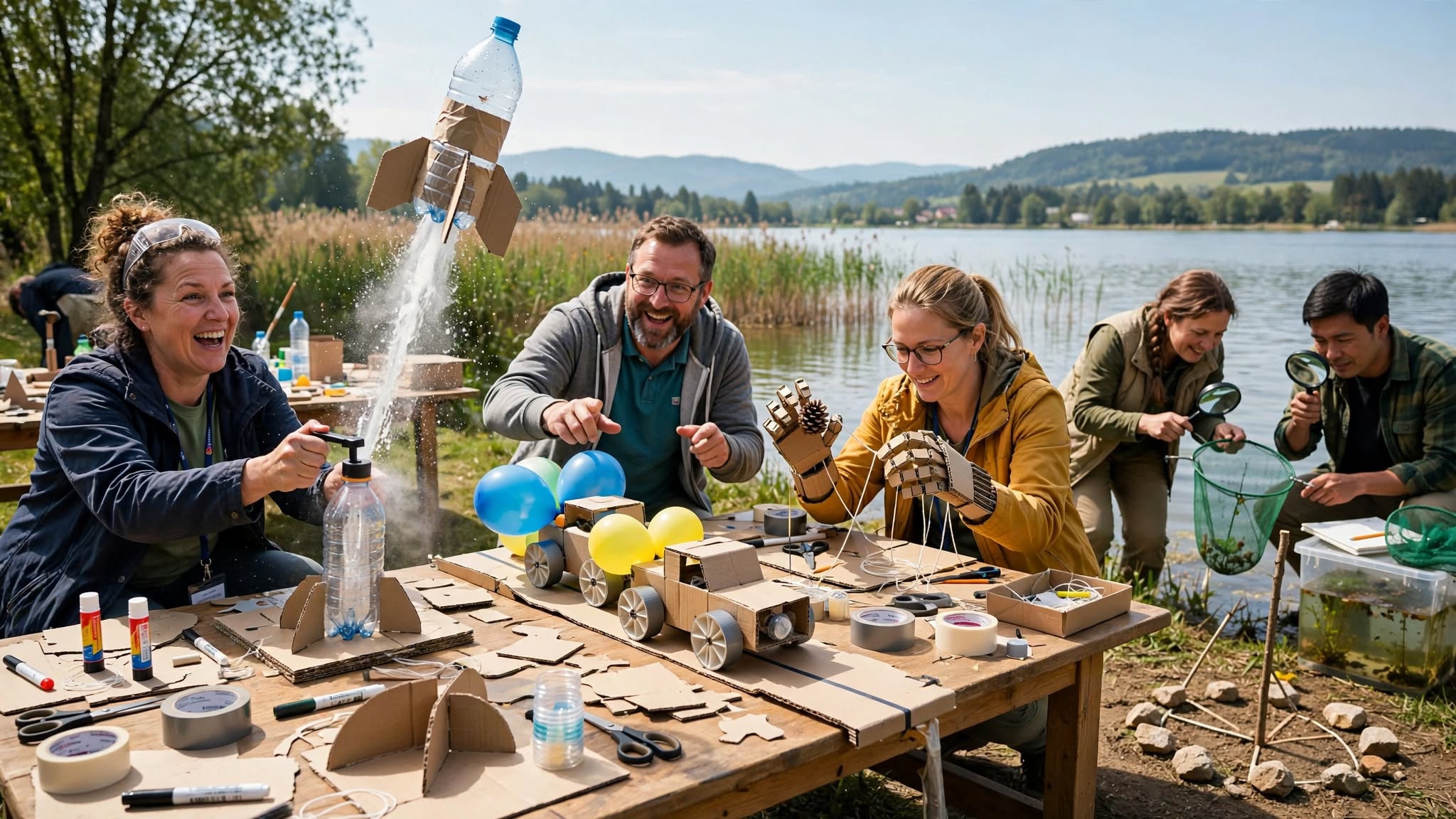
- Run safe, low-cost experiments (balloon cars, water rockets, a sundial, a cardboard robotic arm) and link them to maths, science, technology and art objectives.
- Use VEXCode VR to introduce coding and computational thinking in classes without robot hardware.
- Organise outdoor and field learning, including biodiversity observation in a local habitat, and manage risks outdoors.
- Assess practical student work with rubrics and feedback, and adapt activities for different ages, abilities and special educational needs.
- Create a concrete implementation plan for their own school and share practice with colleagues from other European countries.
Course themes
Engineering design process and inquiry-based learning as a method that can be reused with any topic.
Balloon cars, water rockets and a cardboard robotic arm: forces, measurement, design and iteration with simple materials.
Block-based programming and computational thinking with VEXCode VR, with no hardware needed.
Field work at Ptuj Lake, a sundial, and how to plan and run safe outdoor lessons.
Rubrics, feedback and adapting activities for different ages, abilities and needs.
Comparing curricula and school practice with teachers from other countries and planning future cooperation.
Course methodology
The course is learning by doing: roughly two thirds of every day are practical work in pairs and small international groups, and one third is short input, demonstration and discussion.
Every activity follows the same cycle: try it yourself, measure and reflect with peers, improve the result, then plan how to adapt it for your own students. Participants receive worksheets, example lessons and assessment rubrics they can use directly, and trainers give individual feedback during practical tasks.
Digital tools: VEXCode VR for programming, digital tools for documenting field observations, and a shared online folder for materials and group work before, during and after the course.
European dimension
The course brings together teachers from several European countries. Group work is deliberately mixed by country, and time is reserved to compare school systems, share practice and explore ideas for future Erasmus+ cooperation, such as school partnerships and eTwinning projects. The course supports Erasmus+ priorities of the green transition (nature and biodiversity, learning outdoors), digital transformation, inclusion and quality teaching.
Preparation before the course
About four weeks before the course we send practical information, a short questionnaire about your experience and goals, and the link to VEXCode VR. Please bring your own laptop and charger. For the outdoor sessions bring a sun hat, sun protection, a water bottle, sturdy shoes and clothing for changing weather; we will tell you in advance if anything else is useful.
Programme
30 hours of learning activities over 5 days.
-
Mon12
Welcome, the hands-on STEAM approach and the cardboard robotic arm6 h
Monday 12 July 2027 · 09:00–16:00 (lunch 12:30–13:30)
Introductions, tour of RoboTech STEM Center and a shared picture of what participants want to take home.
The hands-on cycle that runs through the whole week: ask, imagine, plan, build, test, improve and reflect (engineering design process, inquiry-based learning).
First project in teams: design, build and improve a robotic arm made of cardboard, then discuss how the same task works with different ages. -
Tue13
Forces and motion: balloon cars and water rockets6 h
Tuesday 13 July 2027 · 09:00–16:00 (lunch 12:30–13:30)
Morning at the centre: balloon-powered cars. Teams change one variable at a time, measure and compare results, and link the activity to forces, friction and data handling.
Afternoon outdoors: water rockets. Safety briefing, launch rules, test flights and improvement rounds, and how to organise a safe launch with a whole class. In bad weather the rocket session moves to a prepared indoor alternative. -
Wed14
Virtual robotics: integrating STEAM with VEXCode VR6 h
Wednesday 14 July 2027 · 09:00–16:00 (lunch 12:30–13:30)
Programming a virtual robot in the browser with VEXCode VR, with no hardware needed: block-based coding, sensors and navigation challenges in the VR playgrounds.
How to combine virtual and hands-on activities, plan cross-curricular lessons (maths, science, art, computing) and prepare classes that have only computers. -
Thu15
Learning outdoors: biodiversity at Ptuj Lake and the sundial6 h
Thursday 15 July 2027 · 09:00–16:00 (lunch 12:30–13:30)
Morning field session at Ptuj Lake, a short walk from the centre, with guest lecturer Jure Urekar: Biodiversity in practice, what does Ptuj Lake hide? Observing and identifying plants and animals, documenting findings with digital tools and turning a local habitat into classroom material.
Afternoon outdoors at the centre: build and calibrate a sundial, and discuss how Earth, Sun and time connect to maths, geography and art. Risk assessment and organisation of outdoor learning with pupils. -
Fri16
Assessment, implementation plans and certificates6 h
Friday 16 July 2027 · 09:00–16:00 (lunch 12:30–13:30)
Assessing practical work: rubrics, observation and feedback, and adapting activities for different ages, abilities and special educational needs.
Each participant presents a lesson idea from the week and prepares a personal implementation plan for their school. Evaluation, next steps, plans for future cooperation and certificates.
The programme may be adjusted slightly; participants are informed in advance of any change.
Equals the Erasmus+ course-fee flat rate for the whole course.
The fee includes
- Training and teaching materials
- All building and experiment materials for the hands-on activities
- Free access to VEXCode VR (runs in the browser on your laptop)
- Training venue and field session at Ptuj Lake
- Coffee breaks and refreshments
- Certificate of attendance
Not included
- Accommodation
- Lunches and dinners
- Travel to Ptuj and local transport
- Travel and health insurance
Download all course details as a PDF brochure (A4)
How it works
- ApplySend the form below by 11 June 2027. We reply within a few working days.
- We confirm30 days before the start, once at least 6 participants are in.
- InvoiceYour organisation gets an invoice. There is no online payment.
Application and selection
Places are allocated in the order in which complete applications are received (first come, first served). There is no separate selection test. We confirm receipt of your application by e-mail and reply within a few working days. When all places are taken, applications close automatically.
The course is confirmed 30 days before the start, once at least 6 participants have applied. Until then you can cancel free of charge.
Cancellation and changes
Cancellation by you: you can cancel free of charge until the course is confirmed, 30 days before the start. After confirmation we send an invoice. Your organisation can replace a participant free of charge if we are informed in advance.
Changes by us: if the fee, content, dates, location or schedule change significantly, you can cancel at no extra cost with reasonable notice.
If the course does not take place (for example, because the minimum number of participants is not reached) we inform you at the latest 30 days before the start and you pay nothing; any fee already paid is refunded in full.
Force majeure: in case of events beyond anyone's control, such as natural disasters or serious transport disruption, we agree on a new date or refund the fee for the part of the course that did not take place. Travel costs are covered by your own travel insurance.

mag. Oliver Buček
VEX robotics expert, RoboTech STEM Center
mag. Oliver Buček is a Certified VEX Educator, VEX IQ specialist and international conference speaker. He holds a master's degree in Pedagogics, is a Microsoft Innovative Educator, and leads RoboTech STEM Center in Ptuj, Slovenia, where he teaches robotics and STEM and trains teachers to bring VEX IQ into their classrooms.
For twelve years he has coordinated Erasmus+ projects and has completed more than ten that connect schools across Europe. He presents at education conferences in Slovenia and abroad, including in Portugal, Spain, Estonia, Finland and Croatia. Most recently, at the Education Summit 2026 in Guimarães, Portugal, he led two hands-on workshops in April 2026: one on AI vision sensors in VEX IQ and one on introducing the VEX AIR drone in the classroom.
He organises international VEX IQ competitions and mentors students in STEM. In 2024 he received the Inženirska iskra (Engineering Spark) Award for his dedicated mentoring of young people and outstanding promotion of VEX robotics in Slovenia and abroad. Three times he has travelled to the VEX Robotics World Championship in Dallas, USA, as coach and mentor of Slovenian teams.
Oliver believes in learning by doing and uses digital tools to make complex ideas accessible. He leads the course in a practical and supportive style, leaving plenty of room for questions and for exchange between participants.
Jure Urekar
Guest lecturer, biodiversity
Jure Urekar leads the biodiversity module of the course: Biodiversity in practice, what does Ptuj Lake hide? In the field session, participants explore the plant and animal life of the lake and learn how to turn a local habitat into material for their own lessons.
Training institution
RoboTech STEM Center is a robotics and STEM education centre in Ptuj, Slovenia, run by mag. Oliver Buček. The centre offers robotics courses, holiday camps and workshops for children, and training for teachers and kindergarten teachers. It is a certified VEX robotics centre and a member of EdTech Slovenia.
Teacher workshops in VEX 123, VEX AIM, VEX GO and VEX IQ run regularly for Slovenian schools; this course brings the same practical approach to an international group.
- Provider
- RoboTech, mag. Oliver Buček
- Erasmus+ Organisation ID
- E10436304
- Address
- Čučkova ulica 5, 2250 Ptuj, Slovenia
- Contact
- info@robotech.si
The course is eligible for Erasmus+ KA1 funding. It is not accredited or endorsed by the European Commission or a National Agency.
Contact and directions
Oliver Buček, course leader and trainer
+386 70 390 664 ·
info@robotech.si
RoboTech STEM Center, Čučkova ulica 5, 2250 Ptuj, Slovenia · Open in Google Maps
Accessible for participants with reduced mobility (lift to the training room, toilet at the centre).
Venue and accessibility
RoboTech STEM Center, Čučkova ulica 5, 2250 Ptuj, Slovenia. Free parking is available in front of the centre. Ptuj is about 1.5 h by car from Ljubljana and 1.5–2 h from Zagreb and Graz. Participants arrange their own accommodation and travel; Ptuj has a range of hotels and guesthouses, and we are happy to answer practical questions. The centre is accessible to participants with reduced mobility: there is a lift to the training room and a toilet at the centre. Please tell us in the application form about any further needs so that we can prepare the venue and the programme.
The field session takes place at Ptuj Lake, which is within walking distance of the centre; we walk there together. Outdoor activities have an indoor alternative at the centre in case of bad weather. Please tell us in the application form if you need an accessible route or other adjustments for the outdoor sessions.
Inclusion
The course is open to all teachers without discrimination. We adapt activities and materials to participants with special educational needs, as well as dietary and other requirements. Please tell us what you need in the application form.
Certificate
Every participant receives a certificate of attendance with their name, a short description of the course and its learning outcomes, dates, venue, the name of the training provider and of the trainer. The learning outcomes are written so that the certificate can be used together with Europass.
After the course
On the last day each participant prepares a personal implementation plan for their school. After the course you keep access to the shared materials and receive suggestions for next steps, such as extra online resources, ideas for outdoor and hands-on lessons, and ways to present the course to colleagues at your school.
Support, feedback and complaints
Before, during and after the course you can reach us at info@robotech.si; we answer within two working days. At the end of the course every participant fills in an anonymous evaluation form, and we use the results to improve the next course.
Complaints: write to info@robotech.si. We confirm receipt within three working days and answer within 14 days. Complaints are handled fairly and with respect, and the answer explains what we will change.
Frequently asked questions
Who is this course for?
Teachers of primary and lower-secondary schools (roughly ages 8–14): science, maths, technology, computing and art teachers, class teachers, and anyone who wants to bring practical STEAM activities into their lessons.
Do I need robotics or programming experience?
No special prior knowledge is required. Participants need a working knowledge of English (about B1) and their own laptop. Part of the programme takes place outdoors, so please bring weather-appropriate clothing and sturdy shoes.
Is the course eligible for Erasmus+ KA1 funding?
Yes. The course is eligible for Erasmus+ KA1 funding for school education staff. Your organisation applies for the grant through its Erasmus+ National Agency, and we describe the course according to the Erasmus+ KA1 course quality standards. RoboTech's Erasmus+ Organisation ID is E10436304. The course is not an accredited programme.
How much does the course cost?
Participants funded by Erasmus+ pay the Erasmus+ course-fee flat rate of 400 € per person, VAT included; other participants pay 490 € + 22 % VAT per person for the whole 5-day course.
How are places allocated?
Places are allocated in the order in which complete applications are received (first come, first served). There is no separate selection test. We confirm receipt of your application by e-mail and reply within a few working days. When all places are taken, applications close automatically.
How do I apply and pay?
Fill in the application form on this page for yourself or a group from your organisation. There is no online payment: after the course is confirmed (30 days before the start, once at least 6 participants have applied) we send an invoice to your organisation.
What is the cancellation policy?
Cancellation by you: you can cancel free of charge until the course is confirmed, 30 days before the start. After confirmation we send an invoice. Your organisation can replace a participant free of charge if we are informed in advance.
Where is the course held and how do I get there?
RoboTech STEM Center, Čučkova ulica 5, 2250 Ptuj, Slovenia. Free parking is available in front of the centre. Ptuj is about 1.5 h by car from Ljubljana and 1.5–2 h from Zagreb and Graz. Participants arrange their own accommodation and travel; Ptuj has a range of hotels and guesthouses, and we are happy to answer practical questions. The centre is accessible to participants with reduced mobility: there is a lift to the training room and a toilet at the centre. Please tell us in the application form about any further needs so that we can prepare the venue and the programme.
Which certificate do I receive?
Every participant receives a certificate of attendance with their name, a short description of the course and its learning outcomes, dates, venue, the name of the training provider and of the trainer. The learning outcomes are written so that the certificate can be used together with Europass.
When is the course and how long is it?
12–16 July 2027 in RoboTech STEM Center, Ptuj, Slovenia, Slovenia: 5 days, 30 hours, taught in English.
About Ptuj
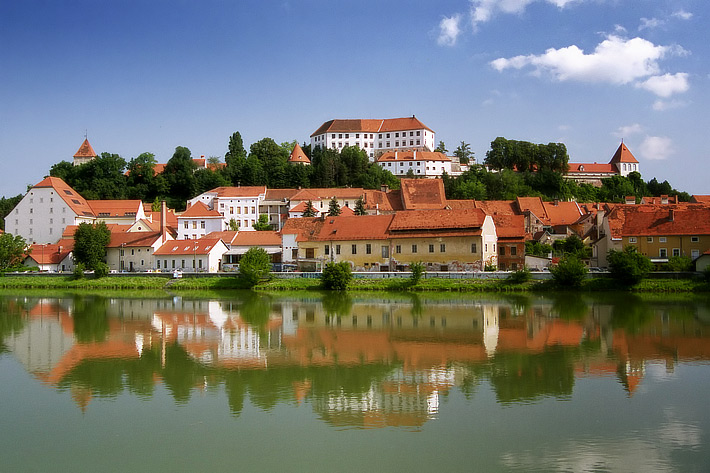
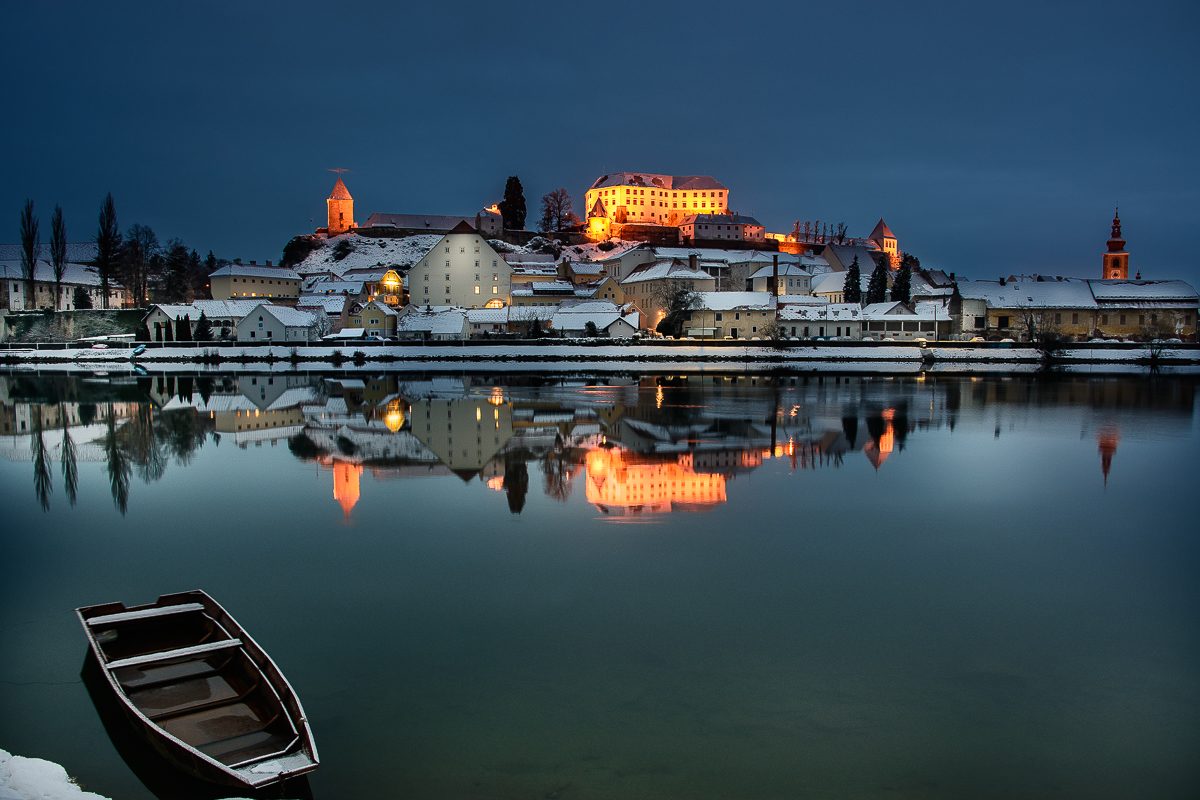
Ptuj is the oldest recorded town in Slovenia. It lies on the river Drava in the north-east of the country, in a wine-growing region close to the Croatian border. The Romans founded Poetovio here, and the old town still has a medieval character: narrow streets, a castle above the river and a compact historic centre that is easy to explore on foot.
Worth seeing in the evenings and between sessions: Ptuj Castle with its museum collections, the Orpheus Monument, the town tower and the main square, the Dominican monastery, and the Ptuj wine cellar, one of the oldest in Slovenia. Local food and wine from the Haloze and Slovenske gorice hills are a good reason to stay for dinner. Ptuj is also known for Kurentovanje, its traditional carnival, which takes place in February.
Getting here: Ptuj has a railway station and a bus station within walking distance of the centre. Maribor is about 30 km away, Graz about 100 km, Zagreb about 100 km and Ljubljana about 130 km. The nearest international airports are Graz, Zagreb and Ljubljana. We are happy to help with directions and with choosing accommodation.
Apply
Fill in the form for your organisation. We reply within a few working days. There is no online payment: after the course is confirmed we send an invoice to your organisation.